Your business alarm triggers at 2am — who actually responds? Here's the minute-by-minute difference between a monitored alarm and one that just makes noise.
Related Services
It's 2am. Somewhere on the Central Coast, a business alarm starts sounding. What happens in the next thirty minutes depends entirely on one decision the business owner made long before tonight — whether that alarm is professionally monitored, or just making noise into an empty street.
Here's how the two very different versions of that night unfold.
Scenario 1: The Unmonitored Alarm
An unmonitored alarm relies on someone hearing it and caring enough to act. In practice, across commercial precincts in Gosford, Erina and Tuggerah, that rarely happens at 2am.
- The siren sounds for a few minutes, then stops — most systems have an automatic cut-off
- Nobody is tasked with responding, so nobody does
- If a passerby does hear it, they can't tell whether it's a genuine break-in or the umpteenth false alarm
- The intruder, if there is one, quickly learns nobody is coming
By morning, the business owner opens up to find the real answer to what happened overnight — broken glass, a forced door, an emptied till or missing stock. In many cases across Wyong and Woy Woy, police report that break-ins at unmonitored premises aren't discovered for six or more hours.
Scenario 2: The Professionally Monitored Alarm
When your business is connected to professional back-to-base alarm monitoring, an activation at 2am sets a defined chain of events in motion within seconds.
0–60 seconds: Signal received and assessed
Your alarm panel sends the activation signal to the monitoring centre. A trained operator — not an automated message — receives it immediately, along with the zone and sensor that triggered it. A glass break detector at the rear door tells a different story to a motion sensor in the storeroom, and the response reflects that.
1–5 minutes: You're contacted, response is dispatched
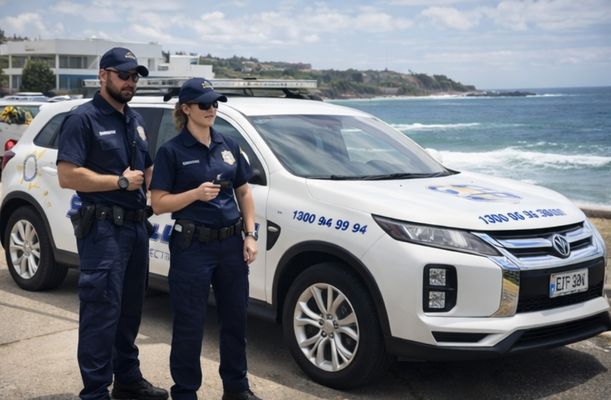
Following your pre-agreed contact list, the operator calls the nominated keyholders. Then a licensed response officer is dispatched to your premises. You'll know there's a problem before you'd have ever noticed a push notification — and there's already a person on the way.
15–30 minutes: On-site investigation
A uniformed response officer arrives, conducts a controlled external check first, then an internal sweep if required. They're looking for signs of forced entry, damaged doors or windows, and whether anyone is still on site.
If the premises are secure and it's a false alarm, the officer resets the system and logs the cause — a sensor fault, a draught moving a roller door, a staff member who forgot to disarm. If it's a genuine incident, the officer secures the site, preserves evidence and involves police where appropriate.
Next morning: You have the full picture
Instead of walking into a mystery, you open your phone to a time-stamped report: what triggered, when the signal arrived, when the officer attended, what they found and what was done. That same documentation is exactly what your insurer wants when you make a claim — and exactly what turns 'someone broke in at some point' into a verified, evidenced incident.
What Sort of Alarms Trigger at 2am?
After-hours activations on the Central Coast typically fall into three buckets:
- Genuine incidents — attempted or actual break-ins, usually targeting rear doors, loading docks or windows concealed from the street
- Equipment faults — failing sensors, flat batteries or outdated panels that drift into false activation
- Human error — a cleaner leaving a door loose, a motion sensor left armed in a staffed area, or an untimed delivery arriving after the system was set
You can't always prevent activations — but a monitored response converts every one of them, false or genuine, into a documented, handled event instead of an open question.
Pairs Well With Patrols
For higher-risk premises, alarm monitoring works best alongside regular mobile patrols — an unpredictable physical presence that discourages anyone from testing your alarm in the first place. And for businesses that keep cash or high-value stock on site overnight, a short-term security guard presence can be arranged for known high-risk windows such as long weekends and holiday shutdowns.
The Question to Ask Yourself
If your alarm went off at 2am tonight, who would actually attend? If the honest answer is 'nobody, until opening time', that's the gap professional monitoring closes — for less each month than a single insurance excess.
Talk to Coastal Protection Services about connecting your Central Coast business to 24/7 back-to-base monitoring and a real, human response plan.
Frequently Asked Questions
What happens when my business alarm goes off after hours?
With professional monitoring, the activation signal is received by a monitoring centre within seconds, your nominated contacts are called, and a licensed response officer is dispatched to investigate. You receive a time-stamped report of the event.
How fast is alarm response on the Central Coast?
Response officers are typically on site within 15–30 minutes of a genuine activation, depending on your location. Monitoring centre contact with keyholders happens within minutes.
Does alarm monitoring handle false alarms?
Yes. The monitoring centre assesses every signal, and a response officer investigates and resets the system if it's a false alarm. Repeating faults are identified and reported so you can fix the underlying cause.
Can I get alarm monitoring if my alarm is already installed?
In most cases, yes. If your existing panel supports back-to-base signalling (via IP, 4G or phone line), it can usually be connected to our monitoring centre. We can assess your system free of charge.
Ready to improve your security? Get in touch with our team for a free consultation.
Get a Free Consultation