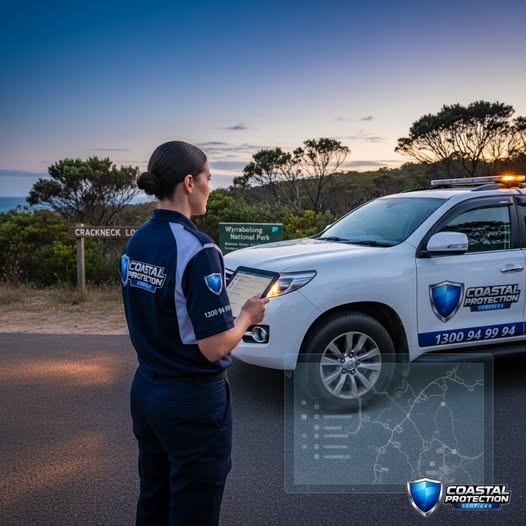
Industrial estates and business parks from Tuggerah to Somersby sit empty for 60+ hours a week. Here's how structured mobile patrols protect Central Coast estates — and how to set up the right program for yours.
Related Services
Industrial estates and business parks are the engine rooms of the Central Coast economy — Tuggerah's commercial precinct, Somersby Industrial Estate, the industrial zones around West Gosford, Ourimbah, Berkeley Vale and Wyong. But when the last truck leaves on Friday afternoon, these estates become some of the quietest, most exposed properties in the region.
Roller doors hiding thousands of dollars of tools, machinery and stock. Long perimeters with no neighbours to notice a cut fence. Common driveways that belong to everyone and are watched by no one. It's exactly the environment that opportunistic thieves look for — and it's why mobile patrols for industrial estates and business parks are one of the most requested services we provide across the Coast.
At Coastal Protection Services, our mobile patrol officers protect estates and individual units from Tuggerah to Somersby and Wyong to Erina. Here's how a structured patrol program works for an industrial property, and why it beats hoping for the best.
Why Industrial Estates Get Targeted
Business parks and industrial estates attract offenders for practical reasons:
- They're empty for long stretches. Most units close at 5pm Friday and stay shut until Monday. That's 60+ hours of unattended premises every single week.
- High-value, easy-to-move goods. Copper cabling, power tools, batteries, fuel, pallets of stock and plant equipment are quick to load and quick to sell.
- Quiet locations. Unlike a shopfront on Terrigal's main street, an industrial unit at the back of a Somersby estate has no passing traffic overnight.
- Shared perimeters. Fences, gates and common areas are often the landlord's responsibility in theory — but in practice, nobody checks them.
The result is predictable: break-ins, theft of tools and machinery, vandalism, graffiti, illegal dumping and unlawful occupation of vacant units. And because damage often isn't discovered until Monday morning, evidence is stale and losses are already locked in.
How Mobile Patrols Work for an Estate
A mobile patrol puts a uniformed, licensed officer at your estate at agreed times — typically several visits per night on a randomised schedule so offenders can't simply wait for the patrol to pass.
On each visit, the officer checks:
- Gates, fences and perimeter security
- Roller doors and shutters for signs of tampering
- Lighting — failed security lighting is one of the most common issues we report
- Common areas, loading zones and car parks
- Vehicles and trailers left on site
- Signs of forced entry, graffiti or dumping
Every visit is logged with arrival and departure times, photos of anything unusual and a written report to your nominated contact. Over a few months, those reports build a genuine risk picture of your estate — which gate keeps failing, which corner stays dark, which unit's roller door never quite locks.
Estate-Wide or Single Unit? Both Work
One of the biggest misconceptions is that patrols only make sense if the whole estate signs up. In practice, we run both arrangements:
- Estate-wide patrols — arranged by the landlord, strata or tenants' association, covering shared perimeters, common areas and every tenancy's external doors. Cost is shared across units, making it very affordable per business.
- Single-unit patrols — a tenant with high-value stock or machinery can arrange dedicated checks of their own unit, inside a larger estate or business park.
We manage patrol programs for estates right across the Central Coast, and we're happy to work with landlords, property managers and tenant groups to design coverage that fits the site — and the budget.
Pair Patrols with Alarm Monitoring
Patrols deter and detect; back-to-base alarm monitoring responds the moment something happens. For industrial premises, the combination is powerful: a monitored alarm activation overnight can be verified and escalated, and a patrol officer can attend to check the premises rather than leaving a broken roller door open until morning.
If your estate's units have alarms that aren't monitored, that's the first gap to close — an unmonitored alarm on an industrial estate is essentially a noisemaker in an empty street.
What About a Static Guard?
For some sites — those with a live-in risk, repeated incidents, or very high-value assets — a static security guard or a combination of guard coverage during handover or shutdown periods makes sense. But for most industrial estates and business parks, a well-structured mobile patrol program delivers the visibility, documentation and deterrence needed at a fraction of the cost of a full-time presence.
Most of the estates we cover run patrols three to five nights a week, with extra visits over weekends, long weekends and shutdown periods like Christmas — when units sit empty for the longest.
Choosing the Right Patrol Frequency
The right schedule depends on the estate, but we usually recommend:
- Baseline: 3–5 patrol visits per week, randomised timing
- Higher risk: nightly visits plus weekend coverage
- Shutdown/holiday periods: increased frequency while premises sit empty longest
- After an incident: short-term intensive coverage while any repairs or investigations settle
Frequently Asked Questions
How much do mobile patrols cost for an industrial estate?
Costs depend on the number of visits, the size of the estate and travel time between sites. Estate-wide arrangements shared across tenants typically work out very affordable per unit. Contact us for a quote based on your site.
Can patrols cover vacant units in our estate?
Yes. Vacant units are frequent targets for squatters, vandalism and dumped rubbish. Regular external checks — and internal checks where access is arranged — keep empty tenancies secure between leases.
Do patrol officers check inside units?
Where access and keys are arranged, officers can conduct internal sweeps. Otherwise, patrols cover external doors, roller shutters, perimeters and common areas.
What happens if a patrol officer finds a break-in?
The officer follows your agreed escalation procedure: secures the scene, contacts the nominated keyholder, arranges emergency trade attendance or police as required, and provides a full incident report with photos.
We're a tenant, not the landlord. Can we still arrange patrols?
Absolutely. Individual tenants can arrange dedicated patrol coverage of their own unit and yard, and we can coordinate with the estate manager where needed.
If you manage or occupy premises in an industrial estate or business park — from Tuggerah to Somersby, West Gosford to Wyong — talk to Coastal Protection Services about a mobile patrol program built around your site.
Ready to improve your security? Get in touch with our team for a free consultation.
Get a Free Consultation